Showing posts with label seafaring books. Show all posts

Tuesday, May 27, 2008

A Respectable Trade


I love to have a Philippa Gregory book to read when I'm going anywhere. They're easy to get through and I don't mind leaving them behind if necessary. So I was glad to pick up A Respectable Trade in the bookshop for €4, but almost put it down again straight away, because it seemed, um, exploitative.

The story concerns a lady of the upper classes who is penniless and unmarried. She ends up marrying a Bristol slave trader, who has this idea to bring slaves into England, have her train them as fancy house servants, and sell them on at a vast profit. Unfortunately for him, his wife develops an, um, relationship with one of the men (which is, of course, the bit I found a bit yeesh) and his business more or less collapses and he goes a bit mental.

On the whole, the book is simplistic and a bit slavery-is-bad-DO-YOU-SEE? But there are some lovely touches in it. Gregory reminds her readers, for one thing, that the kind of investment and trading behaviours she talks about in this book (and has, as is typical of her, meticulously researched) are the kind of behaviours that the men in Jane Austen's books would have been engaging in when not flitting around the countryside saving ladies from consumption. The ridiculous social climbing and the horror of debt that seemed to be a feature of the merchant class in the late 1700s are also well sketched. Overall, I'd have to say her intentions are good, her detail is excellent, but her plot and characterization are weak. The book wasn't quite as cringey as I expected, though.

Monday, December 03, 2007

Breaking Master and Commander news


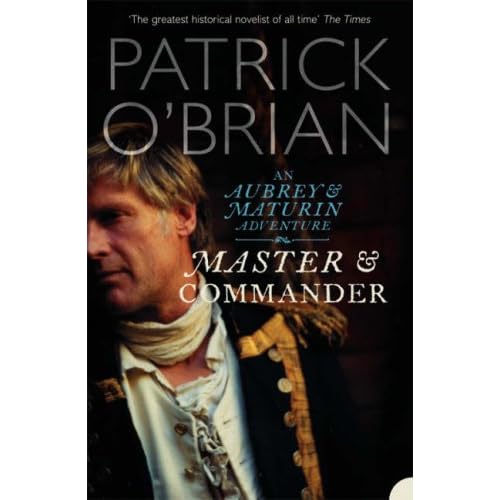
In a recent comment to me, Ian asks if I've seen the new covers for the books. I offer you an example of one here.

Ian reckons these are aimed at the kind of people who read Sharpe books. I reckon they're aimed at GURLZ, because they've removed the ships from the covers and replaced them with people in historical dress, which is what GURLZ like.*

What do you reckon?

Edited later to add:

I am repulsed by these covers, and I think I understand why. Because they remind me (deliberately, I'm sure, as I've said) of the covers for the Philippa Gregory books I read. So I feel like they're being marketed in a reductive fashion that fails to take their true greatness into account.

I realise that this is completely idiotic, given that I am exactly, not just the type of, but the actual woman who reads historical fiction. But Patrick O'Brian books don't have romps and racy sex scenes in them. And, well, you wouldn't understand.


*Oh my god, I'm GURLZ. Jesus, I hate it when I fit a demographic. I hate it even more when marketing people try to sell me things after I've already discovered them for myself.

Post Captain and HMS Surprise


I can't believe the last book I blogged about was way back in September. I really haven't been doing much reading of late, which I suppose is pretty rubbish of me, and what little time I have spent reading has been partly taken up with re-reading Patrick O'Brian books.

Amusingly, I had my copy of Post Captain with me when on holidays and was able to pull it out of my bag when a conversation about Patrick O'Brian came up, leading my pal Dave to wonder if I maybe carry the entire series with me everywhere I go. Of course I don't, that would be a bit mental. But if you had to carry two, I think these would be the two I'd take. First of all, there's plenty of fun adventures by sea in them, with some beautifully written and quite tense battles even if, like me, you have some difficulty with nautical jargon.

Second of all, these are the books that kind of made me fall in love with Stephen rather than Jack. Yes, I know he's not a great catch. He's kind of funny looking and wears a weird wool suit. He is a laudanum addict and a man who loves nothing more than prescribing a slime draught or a yummy purgative, just to teach you a lesson about drinking. He's also not exactly steady on his feet a lot of the time and will, if left to his own devices, eat nothing but bread rubbed with garlic for days on end. He would probably also dissect your granny if you left her alone with him.

On the other hand, he plays Boccerini on the cello and speaks Portuguese, Irish, Latin, Catalan, Spanish, French, Arabic, and a smattering of Urdu. He's funny and smart and ferociously loyal. He's a really good intelligence agent, and an amazing naval surgeon (wouldn't look at you for under ten guineas on land, though). He is a keen naturalist who can sit and stare at birds or beetles for hours on end, and he will walk all day and night to get somewhere he wants to go, or just to have a think.

He is also, somewhat scarily and surprisingly, handy with a pistol. In fact, he's more than handy: he's deadly. He is the kind of man who can fight a duel with someone and then, when they shoot him, he can take the bullet out himself.

Jack, on the other hand, is merely the kind of man who can whip a convoy of East India Company ships into fighting shape, rescue his best friend from torture, get his own ship's company firing two broadsides in under two minutes, and get a beautiful woman to fall in love with him despite him having no money at all from one minute to the next.

Really, who needs new books when you can re-read ones you already love?

Wednesday, August 15, 2007

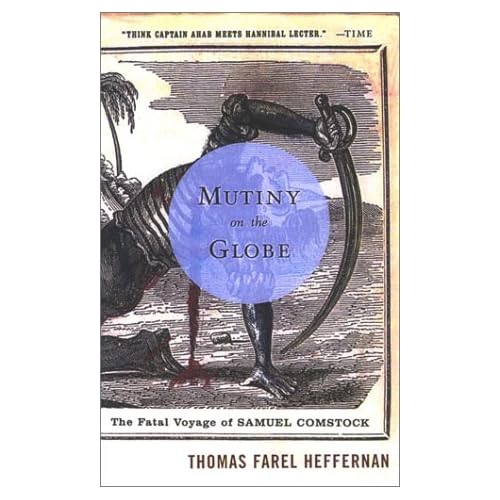
Mutiny on the Globe


Narrative histories about whaleships, mutinies, and shipwrecks are ten a penny, and this one has elements that are familiar to those who've read other ones. Crazy guy thinks he can set up his own society but needs a ship's crew to get him to the right location, then, once he gets there, he kills everyone who's not in on his plan. Gradually, however, he ends up having to kill more and more people in a Richard III stylee.

This book has those elements.

What makes it interesting is what happens after the mutiny is over, which is that the ship fecks off, and two guys are left on an island in the middle of the Pacific with some potentially hostile natives. The book tells the story of how they were, essentially, kept as slaves by the people who lived on the islands, and how they lived there for several years before eventually being rescued by the U.S. Navy. It makes a nice change from being cast adrift in a rowboat and having to eat their shipmates, I suppose, but it does seem to have been incredibly hard work, especially as they could never really be sure they weren't going to be killed, and they were separated from each other almost all that time.

Friday, April 06, 2007

Master and Commander


There are times in a person's life when, for one reason or another, she is a little low. It could be that she's been coughing constantly and violently for four months and has recently been to the doctor and received a tentative diagnosis of possible asthma, with the recommendation that she gets rid of her cats. It could be that her house is still crowded and her parents have been in and out of hospital for minor procedures that could turn into major procedures down the line. It could be that she hasn't really been doing a whole lot of anything lately and just feels a bit meh.

At times like these, a person needs to re-read Master and Commander. There just is no finer antidote to a dose of the meh. If you are a regular reader of this blog, or anyone who has come into casual contact with me over the last few years, you already know how I feel about this book and the books that follow it. I will simply remind you, therefore, of the tender friendships and the sharp humour, the nautical noise and the naturalistic quiet, and the bright fresh air of the open sea.

Friday, January 19, 2007

Let's post drunk!


I've had a large measure of sippin' tequila and a couple of beers and I'm pleasantly drunk. What shall we talk about? I've been talking about the horrors of Celebrity Big Brother all day with my internet pals, and I'm bored doing that now. I'm only still watching it because I am fascinated by older Dirk Benedict. I haven't seen him, even a picture of him, since about, what, 1985 or something? It's so strange to look at him now. I feel like I went to school with him or something. He looks so much the same, but older. And more right-wing. It's so strange.

Celebrity Big Brother would be greatly improved by less bullying and racism, and more Dirk Benedict face down in the mud scrambling under a net with Jermaine Jackson and H from Steps singing the music from the A-Team out of the back of a limousine at him. I mean, how could any Sopranos dream sequence compete with something like that?

You know what? I feel down. And why? Because I haven't finished reading a book since the middle of November, and I kind of miss writing my book.

And I miss Jack and Stephen.

Feel warm though. Yum yum. Sleeps.

Tuesday, September 12, 2006

The Golden Ocean


Some time ago, I talked about the voyage of Commodore Anson into the great South Sea. Here's what I said:

In 1741, Commodore George Anson set sail from England with five ships and a total crew of approximately 1400 men. He had orders to sail to South America, map some territories and harass Spanish shipping. He had a diasastrous voyage and returned with one ship and about 500 men. But along the way he captured prizes worth about £400,000.


Well, Patrick O'Brian thought it would be a capital idea to write a novel based on the adventures of two young Irish lads who sign on for Anson's voyage. Luckily, and I don't think it's giving away too much to say this, they have a fondness for lemons. This is a lovely precursor to the Aubrey-Maturin books, and it only makes me sad and wistful to have finished it so fast, bringing me ever closer to the end of O'Brian's works.

Wednesday, July 19, 2006

Ahab's Wife


Now this is more the thing. An enormous modern take on the epic 19th century novel. A woman's perspective on whaling, a companion piece to Moby Dick, a book that takes every living thing that whaling stories of the time exclude - women, dwarves, dogs, cats, children, slaves, Indians, and openly gay men - and crams them all into one big stove-by-a-whale, ate-my-shipmates, lived-in-a-lighthouse, married-not-one-but-two-nutters, met-Frederick-Douglass-and-Nathaniel-Hawthorne romp. You know the kind of thing. This is a superb book. I recommend it unreservedly.
And I really want a print of that picture on the front, too.

To Hell or Barbados


Perhaps it is that I have finally read everything there is to read about the sea, but more likely it is that Mr. O'Callaghan is not the best writer of narrative history, but this is not an interesting or particularly enlightening book. It tells you in 250 pages that Cromwell sent somewhere between 12,000 and 50,000 Irish people to Barbados as slaves.

And that's kind of it. If you've never read a book about slavery, or transportation, or colonialism, I guess you might get something out of this, but even then it's not very well put together. It is not necessary, in a 250 page book, to repeat information. It's even less necessary to repeat the gory details of the 17th century slave trade, but he does. Lazy editing? Padding? Either way, not the most impressive. I'm sure a really good narrative historian could do a lot with this material, but... you get my drift.

Friday, July 14, 2006

Tuesday, July 04, 2006

Sea of Glory


How is it, Nathaniel Philbrick asks, that a squadron of American ships can sail to Antarctica and be the first to map it as a continent, make some of the most useful charts of Pacific islands (some of which were still in use until the Second World War), come back with a collection big and important enough to start up the nation's first public science museum (the Smithsonian), and draw up some of the most accurate charts of the American northwest, and no-one has ever heard of them?
The answer: politics and bad management skills. Charles Wilkes, leader of the Exploring Expedition, was not a facilitator. He was a maverick and an ambitious weirdo who didn't know anything about the sea. He was promoted into a job he wasn't trained for and left hanging by the people who stuck him in there. When he got back from doing his job, he was buried because he raised too many questions and was unpopular. Sounds familiar?

Depressing, isn't it?

Happy July Fourth, America.

Wednesday, May 31, 2006

The Pirate Wars Vs. The Prize of all the Oceans


Several years ago I had an argument with some people about Pirates of the Caribbean: Something Or Other About a Pearl, I Think and Master and Commander: The Far Side of the World, two films about the Great Age of Sail. I didn't like the pirate film as much as the one about the British navy. At the time I put this down to many things. One, I wanted to annoy the people I was arguing with.
Two, the pirate film was a fairly hacky summer blockbuster that was crying out to have been made by Rob Reiner but instead was made by Gore Verbinksi, so instead of being The Princess Bride it was more like Cutthroat Island.
Three, I hate fun. I don't really hate fun, but everyone thinks I do, so I may as well go along with it.
Four (and really, this is the main one), I'm just not that interested in pirates. I don't know why. They sail around in ships and have adventures. They board other ships, launch broadsides against their enemies, live in caves and drink rum. They have a special pirate code (no, they really do) and they live in groovy little colonial outposts in the Caribbean. But I don't care.

Sadly, Peter Earle's book didn't do anything to make me care any more. For a start, it's a bit too much of an overview, and if I like anything, it's a detailed history of one bit-player who turns out to be pivotal in the whole history of everything ever (see Nathaniel's Nutmeg for the best example of this) and provides you with a great test case. But Earle doesn't do this. He sets out his store in good scholarly fashion, tells you what he's going to tell you, then tells you it, citing examples along the way. It ends up being a bit routine. There were pirates here. So the British government sent out ships and passed laws and gradually arrested or killed all the pirates so then there were no pirates. The end. Not packed with dashing incident and anecdote, as one would hope.

Ne'er mind, Vicar. But you did a lot better with The Prize of all the Oceans. In 1741, Commodore George Anson set sail from England with five ships and a total crew of approximately 1400 men. He had orders to sail to South America, map some territories and harass Spanish shipping. He had a diasastrous voyage and returned with one ship and about 500 men. But along the way he captured prizes worth about £400,000. Glyn Williams details everything about the expedition and it's all really exciting, including the adventures of the Wager, one of the smaller ships, which ended up wrecked on a remote island in South America, leaving the crew stranded and forced to find their way back to England in a bewlidering variety of ways. A fantastic book, well worth reading. Not least because the Chinese couldn't tell the difference between His Majesty's ship of war towing a prize and, well, pirates.

Sunday, April 30, 2006

This Thing of Darkness


This is Harry Thompson's first novel, and if I'd commissioned it myself, I couldn't have asked for something more suited to my own tastes.

Write me a book, I would say, that fictionalises real events and people. Give me a tragically flawed hero in the old naval mould, who commands a ship with panache and courage, and who is constantly fighting with his naturalist sidekick, who has many old-fashioned ideas of duty and kinship and who is always on the side of the weak and downtrodden. Give him some interesting scientific ideas that are rejected by the establishment but which are ultimately proved to be correct.

Except I would have said, don't kill him at the end. Leave it open for a sequel. Perhaps that's why it's as well I wasn't the one commissioning this book, because then you wouldn't have got the story of Captain Robert Fitzroy, commander of the Beagle and exuberantly religious foil to Charles Darwin and his new scientific discoveries. The whole book is a marvel, very much in the Patrick O'Brian vein, full of intellectual discoveries and quarrels and adventures and boys' fun, but, because the characters are real people, it's also full of the nastiness, selfishness, sickness and depression from which real people suffer in a way that fictional people do not. Darwin comes over, not as unlikeable, but as ambitious, vain, and a little spoiled. Fitzroy himself is a manic depressive and something of a Tory snob. Darwin is prepared to make his own mind up about the things he sees and hears, while Fitzory shoehorns everything into his existing view of the world. Darwin is the fittest who survived, Fitzroy is the old order who didn't.

Tuesday, March 21, 2006

FFS!


It's amazing how some things can really push your buttons. I was so close to giving the staff in Waterstone's a piece of my mind, and then, just like that, I couldn't be arsed.

Still though. For fuck's sake.

Sunday, January 08, 2006

The Fatal Shore


It is a constant source of disappointment to me that Mister Monkey can read history books galore and actually retain facts from these books, while I learn only vague concepts. For example, he has just finished reading a big fat book about Persia and has learned many exciting things about Persia which he will happily share with you (if he ever updates his bloody blog, that is). I read a whole exciting novel about Persia last year, and the only thing I can remember is that there was once a Persian king called Arses.
I'm a bit like that about Australia now. Even after reading six hundred fairly dense pages about transportation and the colonial beginnings of Australia, all I can really tell you is an amusing story about a bloke called Pearce who was a cannibal. Or that you really, really didn't want to end up getting transported to Norfolk Island. Or that you didn't want to be a woman who got transported. Otherwise, there were worse things that could happen you than being sent to Botany Bay. In general, you worked hard, you got your ticket-of-leave, and you had a chance to be set up with some land and you could get some convicts of your own and start your own farm or business or whatever it was you had been doing in Ireland or England before you got greedy or stupid and did whatever it was that got you transported in the first place. In fact, one of the British government's biggest problems, once the colony was up and running, was to retain some sort of threatening air about it, which was very difficult seeing as how things were pretty crap for the English poor at that time.
It's a very good book, even if it does repeat itself a little and sometimes there's a little too much talk about architecture for my liking (namely, any at all. I don't care about architecture), but there's no way it should have taken me two months to read.

Thursday, October 06, 2005

43: No spice is worth this


At this stage I consider myself something of a connoisseuse of popular history books concerning ships and the sea, and Giles Milton's Nathaniel's Nutmeg is right up there with In the Heart of the Sea as one of the best. Telling the story of the spice trade from the British point of view, Milton has great anecdotes about the beginnings of the wars between Britain and the Netherlands, the formation of both the British and Dutch East India Companies, the reasons for the high value of spices, and some lovely stories about the lives of the people who explored, fought over, and traded with the natives on these remote and hostile islands.

And yes, these books do follow a pattern, as the LRB says. They invite you to imagine a world without the thing the book is about, in order to build up its importance and make you believe that the main subject of the book (invariably some person of great character who has been consigned to the fringes of history in a way that makes you wonder about the fate of Neil Armstrong (especially given that there are already twenty year-olds who don't know who he is)) is a greater historical figure than Nelson or Magellan. Which of course they aren't, unless you're a chemist or a cartographer or lexicographer or whatever kind of specialist the author is.

The most interesting thing about this book, though, is that it starts off being about one thing and ends up being about something else entirely. And for once - hats off to Sceptre for this - the blurb on the back doesn't give away the whole point of the book, so there is actually a nice surprise at the end. Top notch.

Tuesday, August 23, 2005

37: The end of the Empire


Fragrant Harbour is another quality page-turner from John Lanchester. It tells the story of a family's blah against the backdrop of blah in Hong Kong blah. Alright, it's more interesting than that, but any plot summary is going to make it sound like any other family saga, because essentially that's what it is, even going so far as to start at the present day and work back. But the characters don't get caught up in the turbulent times of post-war Hong Kong any more than the story requires them to, and there is no magic realism of any kind anywhere in it, nor does anyone turn out to be a hermaphrodite. This is just straight-ahead storytelling where the story and the characters and the historical backdrop are interesting enough to do away with any quirks or gimmicks. Knowing nothing at all about Hong Kong doesn't make it any harder to follow, and in fact now I suspect I would find the place a little easier to navigate, if I was ever thinking about going there, which I am not.

Thursday, August 04, 2005

Tutti frutti ice cream!


Did you even know that there was a huge shipping trade in ice in the late 1800s? Me either. Would you have said such an idea was crazy? Me too. But there it was. And Gavin Weightman's The Frozen Water Trade is the book to tell you all about it. I liked this book enormously, even though the subject matter is a little dry. Like a lot of overnight sensations, the ice trade took a very long time to be take seriously, but once it was up and running, it took its inventor out of debt and was making him $40,000 a year in profits. Ice was sold as far away as India, and it is this trade that explains why American drinks are so much colder than ours, and why they call their fridges ice boxes.Shipping, commerce, the industrialisation of America, it's all here in a very compact 200 pages. Recommended.

Tuesday, June 07, 2005

27: yarrr


I'm amused to see that the new edition of Scurvy has had its subtitle changed from "how a surgeon, a master mariner, blah blah solved the greatest medical mystery in the Age of Sail" to "helped Britain to win the Battle of Trafalgar". Now that's a pretty good cash in on an anniversary, no?*

Anyway, this book isn't really as interesting as you might think it's going to be. It has plenty of opportunity to be interesting, given that it gets to cover

* the symptoms of scurvy (unpleasant)
* the prevailing medical theories at the time (a bit daft)
* the living and working conditions of mariners in the Great Age of Sail (appalling)
* the career of Captain James T. Cook (brilliant)

But somehow it still manages not be a very interesting story. I think the problem is that the author tries to present it as a narrative, and it doesn't make that interesting a narrative because it's a bit like once upon a time there was scurvy, and some people tried to cure it using X, but it didn't work. Then they tried to cure it using Y, but that didn't work either. Then they tried to cure it using Z, and that did work but it was too expensive to use on a daily basis, so they didn't use it. Then England went to war and decided that scurvy really needed to be cured, so they cured it. The end.

I suppose the most interesting thing about that is the notion that governments only bother their arses trying to cure fatal diseases when there's a danger that the national economy and/or security will be compromised because all of the able-bodied men and women who are working/defending the country are dropping like flies.

Hmm, I wonder if there's any comparison to be drawn between this and the HIV/AIDS epidemic? Hmm.

*This year is the 200th anniversary of the Battle of Trafalgar.

Thursday, May 26, 2005

23:Set sail for...


It's impossible to talk about Cochrane: Britannia's Sea Wolf without talking about Jack Aubrey as well, so I won't bother taking that approach. And indeed, on the back of the book you are warned to have read your fill of Patrick O'Brian and C.S. Forrester before you open this book, for once you look upon the deeds of Lord Thomas Cochrane, all fictions will pale by comparison.

And to an extent (a very large extent), this is true. The things that Cochrane did were truly amazing. He took on and beat French ships twice his size. He took so many prizes on one mission that he had only 23 men left on his own ship, not enough to man a gun crew, and then he took another ship by firing only the bow chasers at her, because her crew reckoned that only a maniac would come after them if he didn't have an enormous crew.

Cochrane was that maniac. A fighter in all things, a scrupulously honest man, he was also a parliamentary reformer and (sadly) a bit of a mentalist. He was an inventor and a man to hold a grudge. He was a man at sea on land, just like Jack Aubrey. In fact, many of the scrapes and escapades that Jack gets entangled in come from Cochrane's life.

But take heart, even if you've read this book and are thinking about reading some Patrick O'Brian. This book isn't funny. There is no choosing the lesser of two weevils here. There's no Stephen, no intrigue, and no real character portraits of any of Cochrane's faithful crew (well, you'd be faithful too if you were taking the kind of prizes these guys were), who surely must have been a huge help in carrying out his lunatic plans.

What there is, though, is an excellent account of the life of an extraordinary man, an interesting overview of the senseless waste and corruption that was rampant in Britain at the time, and some fantastic sea battles to re-enact with your cruet set whenever you have friends over for port.